
Artificial intelligence
How Opsera Build a Consistent, Always-On Content Engine with Vidoso GPT+
Every marketing leader eventually types a version of this into ChatGPT: “How can I use AI to create all my campaign assets?”
The goal is clear. You want a system that can transform one campaign concept into every deliverable your team needs without losing quality, consistency, or nuance.
That is what Vidoso’s AI campaign playbooks, also called campaign recipes, make possible.
What most teams get wrong about using ChatGPT for campaigns
Traditional prompting feels fast until it does not. You start with one brief, paste it into ChatGPT, and prompt for each deliverable such as an email, a blog, a post, or a video script. Every version requires new context, tone adjustments, and manual editing.
After a few assets, you often end up with mismatched voices and uneven quality. You save time at first but spend it later fixing inconsistencies. Each new campaign starts from zero. No system remembers your structure, personas, or preferences.
Vidoso’s AI campaign playbooks change that dynamic.
What is an AI campaign playbook or “campaign recipe”?
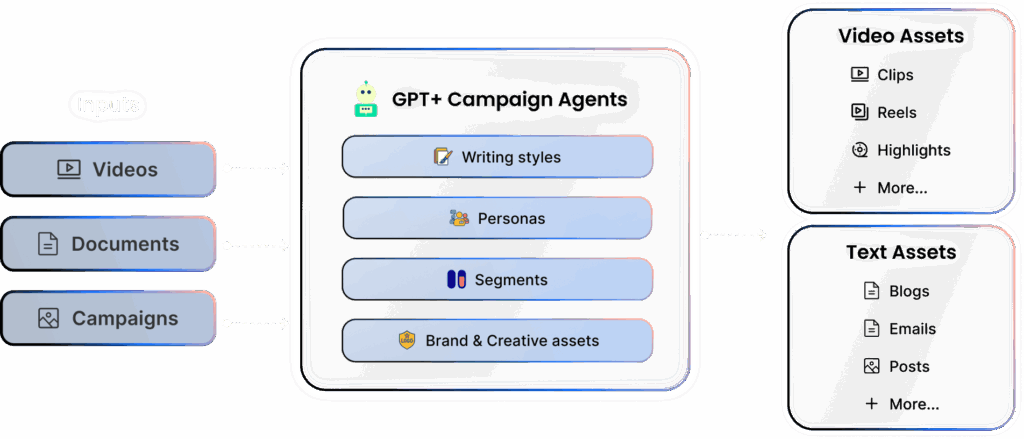
A campaign playbook is a reusable framework that tells AI how to generate a complete suite of campaign assets from one source input.
Think of it as your marketing assembly line. You define the recipe once, including emails, social posts, blogs, one pagers, and video scripts, then reuse it whenever you need.
Instead of prompting for each new deliverable, you run your recipe with a new campaign brief, product launch deck, or article. You set it up once and run it many times.
How a campaign recipe actually works
- Start with your source asset. Upload a brief, PDF, video, or article. This becomes your campaign’s raw material.
- List every asset you need. Define the bundle, such as a launch email, a LinkedIn post, a customer announcement, and a one pager.
- Assign audience and style. Each asset knows its persona and tone, such as C suite versus practitioner, product versus brand.
- Click Run Recipe. In minutes, you receive every asset versioned, formatted, and aligned with your style guide.
The AI does not replace your judgment. It scales it. You still direct the strategy, audience, and nuance. The system handles the repetitive execution.
How AI turns one campaign brief into every asset you need
AI models can interpret your campaign source, whether it is a document, transcript, or video, as structured knowledge. With a well defined playbook, they can:
- Identify the core message and reframe it for each channel.
- Adjust tone and detail for different audiences.
- Generate multimodal assets, including text, video scripts, and image prompts, from the same base content.
- Preserve semantic alignment so every piece stays on message.
From a single launch brief, the recipe can produce a customer announcement email, a product blog, a CEO LinkedIn post, a 30 second video script, and a one page sales summary. Each asset fits its channel, voice, and context.
Why marketers call this the assembly line of content
When you systematize campaign creation, you remove creative drag. You do not need one off prompting or endless revisions.
The result is simple, less chatting, more shipping.
Three consistent benefits
- Speed: Full campaign suites created in minutes instead of weeks.
- Consistency: Every asset follows the same strategy and tone.
- Scalability: Anyone on the team can run the recipe, not just AI experts.
This is the marketing equivalent of moving from hand built to precision built campaigns while keeping creative quality intact.
How this differs from one-off ChatGPT prompting
Prompting is about getting one answer. Playbooks create a repeatable system that delivers quality every time.
- Prompting equals one time generation.
- Playbooks equal structured, repeatable production.
In a playbook, you define once how AI should work for your brand and reuse that logic for every launch, webinar, or nurture program.
Instead of saying, “Write a blog about our new feature,” you have a system that already knows your personas, your communication style, the formats you need, and the tone your brand requires.
Can AI handle formats like video, images, and copy?
Yes. Multimodal AI connects these formats into one workflow. A modern playbook can take a single input and produce text, audio, video, and visual outputs that align with one strategy.
- A video script becomes a short clip and an image caption.
- A whitepaper turns into social graphics and sales slides.
- An interview transcript becomes a blog post and an email sequence.
Each format reinforces the same message across every channel.
Brand compliance and nuance at scale
AI without brand context leads to inconsistency. Campaign playbooks solve this by encoding your brand rules in every output.
They follow your tone of voice, product naming, formatting, and content hierarchy. They can reference supplemental materials such as meeting transcripts or customer research to add nuance.
Your AI system does not only repeat your words. It reflects your communication style and priorities. For companies managing multiple products or markets, this is essential. Consistency becomes built in instead of manually enforced.
How fast campaigns can really be produced
Once your recipes are defined, campaigns that used to take weeks can be ready in under an hour. Human review focuses on refinement, not reconstruction.
Marketers maintain control of messaging and creative direction. AI manages execution at scale. The more you use your recipes, the faster and more consistent each campaign becomes.
Who benefits most from AI campaign playbooks
Campaign playbooks work for any B2B team running repeatable campaign types.
- Product Marketing: Turn one launch brief into every announcement asset.
- Demand Generation: Build nurture sequences, landing pages, and ad copy in minutes.
- Content Marketing: Repurpose podcasts or long form pieces for every channel.
- Sales Enablement: Create customer ready decks, one pagers, and talk tracks instantly.
Each team gains time for strategy and creativity instead of repetitive assembly.
Do marketers need technical skills?
No. Most tools are no code and built for marketers. You define templates, tone, and formats in plain language. Vidoso was built with marketers in mind, and does not require complex prompt engineering.
The AI handles the orchestration, how prompts connect, how context is applied, and how assets are generated. If you can describe your campaign process, you can automate it.
Where Vidoso’s Campaign Playbooks fit in
Among the available options, Vidoso’s Campaign Playbooks stand out for a structured and repeatable approach. They turn the one off act of asking AI for content into an operational system any team can use.
You create your recipe once. You define your assets, assign personas, and set tone rules. From then on, every campaign runs in minutes with a single click.
No prompt editing marathons. No dependency bottlenecks. You get repeatable and human aligned marketing execution.
What changes after adopting AI campaign playbooks
- From fragmentation to focus: Assets align automatically around one story.
- From burnout to balance: Time shifts from repetitive work to creative refinement.
- From dependency to empowerment: Every marketer can run a campaign independently.
The creative direction stays human. The execution becomes effortless.
Closing thought
Vidoso’s AI campaign playbooks do not replace marketers. They remove the mechanical friction so marketers can work at the speed of their ideas.
You define the vision once. The AI helps you execute it again and again with precision, consistency, and your voice intact.
See Vidoso in action.
From a brief to 100s of brand-aligned, personalized assets in minutes
Trusted by top marketing teams.